
Did you know?… Playing music stimulates more parts of the brain than almost any other activity.
United Kingdom
- Caregivers
- Children
- Disability
- Interactive Music-Making
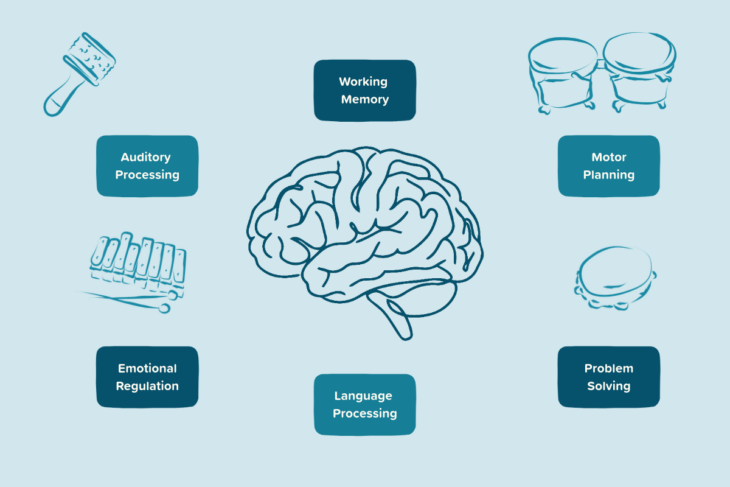
Playing music stimulates more parts of the brain than almost any other activity:
- Auditory processing
- Working memory
- Language processing
- Motor planning
- Emotional regulation
The Interactive Music-Makers we train use music to stimulate all these parts of the brain and to support all areas of a child’s development.
Auditory processing:
In Interactive Music-Making (IMM) sessions children listen to and play different musical instruments, exploring a range of rhythms, pitch and volume. They listen to the musical sounds of others, developing awareness of their peers.
Working memory:
IMM sessions give children time to develop their listening and attention skills. They will learn to recall words of songs, to anticipate movements and which instruments to expect, within predictable musical structures and activities.
Language processing:
The songs used within IMM sessions – to support transitions, to give instructions and to help children understand turn taking – help children process language. Rhythm makes language patterns more predictable and easier to recognise; the shape of the melody and repetition can help children recall and sequence words.
Motor Planning:
IMM sessions are spaces where young children can develop their motor skills, from joining in with action songs to playing a drum to the beat of a song. Children in IMM groups will develop impulse control, waiting for their turn to play the cymbal or following musical cues to play quietly or slowly.
Emotional regulation:
IMM sessions and the musical activities they entail give children confidence and new ways to express a range of emotions. They may also learn to regulate their emotions, using music-making as a positive outlet through which they can channel strong experiences or feel their smaller emotional experiences can still be understood by others. And if a young child is able to better regulate their own emotions, they then have greater capacity to consider the experiences of others, to develop empathy and understanding.
We’ve lost track of the number of times our Interactive Music-Makers tell us the positive change they see in the social skills developed by the children who participate in their sessions, the pride they take in seeing children learning to share musical instruments with others, taking turns, developing new friendships and growing in confidence.
Apply now for Interactive Music-Making 2026-27!
Applications are now open for our upcoming Interactive Music-Making programme running from East London in Spring.
We offer FREE Award places for eligible early years practitioners, alongside subsidised options.
If you are applying from an early years setting and wish to apply for an Award place (available to early years settings only, max 1 Award place per setting):
- The applying practitioner should complete a Student Application Form
- The setting manager should complete the Award Application Form
To apply for a fully paid or part-subsidised place, the applying practitioner should complete the IMM Student Application Form only.
Apply by Thursday 3rd December 2026 or get in touch with any questions: zackmorrisjones@musicastherapy.org
To find out more, head to our Interactive Music-Making page or email zackmorrisjones@musicastherapy.org
Related projects
-
Structured Training: Interactive Music-Making (London) 2026
United Kingdom
- Caregivers
- Children
- Disability