
Amelia’s Story
United Kingdom
- Children
- Disability
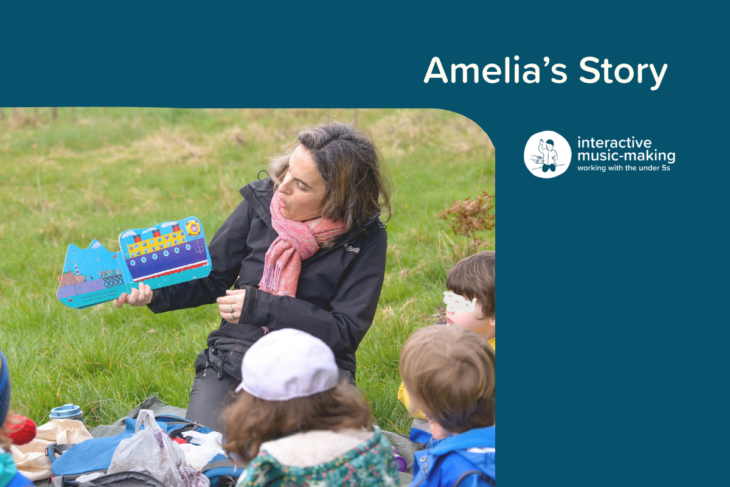
Amelia Aptaker runs Puss in Boots nursery school for over 35 children (60% of whom have English as a Second Language) aged between two and five near Belsize Park in London. In 2024, she successfully applied as one of our brilliant Interactive Music-Making (IMM) students. Since graduating, Amelia has had time to reflect on the training and her experiences with it and has been kind enough to share her story with us.
Before Amelia’s introduction to IMM, her nursery and its staff were limited in their ability to provide music sessions for their children despite an awareness of its potential.
We were using as much music as we could with our training and capacities. We actually had an external company come in weekly because we didn’t have any kind of music expertise internally.
This appreciation and value of music led Amelia to take singing classes, where, by a stroke of luck, she met the daughter of one of someone who had previously worked with Music as Therapy International who encouraged Amelia to apply to the IMM course.
Reflecting on her feelings before the course started compared to her understanding having completed the course, Amelia admitted that the realities of the training far outperformed her expectations, especially regarding the educational standards of the content.
I’ve said it many times, but it was a really impressively taught course. There was a huge amount packed in, and it was quite different from what I’d been expecting. I hadn’t been expecting as much pedagogy and child development theory. It was very pragmatic and very practical.
From all the teaching points and lessons Amelia gained from her training, one stood out from the rest: unconditional positive regard. In simple terms, this means accepting and supporting someone and their behaviour without conditions or judgements. Amelia has been able to take this concept and use it in her everyday teaching, seeing it as a fundamental part of early years education.
That was actually my favourite. If you ask me what my biggest takeaway was, it was the term ‘unconditional positive regard’. I think about it all the time. It just encapsulates what we, as early years teachers, should do every day.
Since completing the IMM course and graduating, Amelia has continued to put what she learned into practice, leading her own music sessions weekly and expanding to multiple different groups. The support from IMM tutors and the rest of her colleagues has given Amelia the confidence to explore new techniques, activities and approaches to her sessions.
We’re still running those [IMM sessions] and run a couple more groups since. Those are really positive and continue to have those same positive benefits for the children. (…) And then you just find yourself singing a lot more. I’ve been more confident singing and personally, I’ve really enjoyed that.
But it’s not just Amelia whose confidence has grown… Over the course of her IMM sessions, she noticed huge changes with some of the children she’s been engaging with; using their voices, coming out of their shells and socialising more with other children. Amelia has seen this transformation outside of IMM too, with parents, family members and wider staff noting the change.
Everything is positive and all the interactions are positive, I think [IMM] really boosts their confidence and helps them connect with others as well. I’ve definitely seen a huge boost in the confidence of the children in that session.
A large part of what enables this continued success is the ongoing support provided to our IMM graduates with termly Continued Professional Development (CPD) meetings. In these meetings graduates are encouraged to share experiences, challenges, insights and more, as well as being able to ask instructors for professional advice on certain issues or difficulties they may have been having. This tangible support, alongside the benefits of reconnecting with peers and colleagues fosters long-standing relationships and the necessary reassurance to keep providing IMM sessions.
I think the support afterwards is important, the option to join a Zoom session to stay connected with peers. (…) I got some ideas going back to Hackney. I came back thinking I’ll do this, and we’ll do this and we’ll do that. And I think that is really valuable. I think it was a brilliant course, and that keeping in touch as much as you can do it. I bet however many you [MasT] get on the call, I think they’ll really benefit from it.
Amelia has made the most of this partnership, imparting her knowledge and skills onto other colleagues and even joining us in 2026 as an IMM ambassador to chat to the 25-26 IMM participants about her personal experience with the course. Acting as an inspiration to others, Amelia has championed the IMM course and its benefits for both children and teachers alike.
There is a real scarcity of high-quality teaching training for Early Years practitioners – this training will not just teach someone how to be an Interactive Music-maker – it will make the participant a better teacher and practitioner. It’s outstandingly delivered teaching that covers so many areas that can impact positively on your work. Practical ideas, theories of child development, teaching pedagogy. A really special opportunity to learn as part as a group of colleagues. I think it’d be brilliant for everyone, whatever level they’re coming in at.
We are so lucky to work alongside such dedicated and enthusiastic EY practitioners, and we hope stories like Amelia’s will continue to inspire others to take part in this “brilliant course”!
Applications for the 2026-27 Interactive Music-Making course are now open! Apply now by filling out the form here: IMM Student Application Form / IMM Award Application Form.
Visit our Interactive Music-Making page or contact our Training Assistant, Zack Morris-Jones at zackmorrisjones@musicastherapy.org for more information.
Related projects
-
Structured Training: Interactive Music-Making (London) 2024
United Kingdom
- Children
- Disability