
Miriam’s Story
Kenya
- Children
- Disability
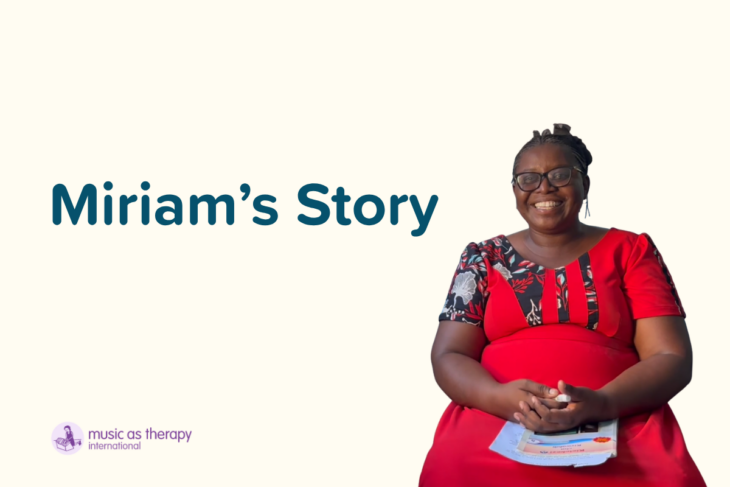
Miriam is the head teacher of Bombolulu School of Promise in Kenya, a school supporting children aged five to twelve, many of whom are orphans or come from families facing hardship. The school was founded and set up as a charity by Jacqui Furlepa, a music therapist from England. Katy and Sarah, who delivered a Tailored Training (on-site) on behalf of Music as Therapy International in 2025, visited the school in May this year to see how the teachers were getting on with their music sessions. While they were there they captured Miriam’s story.
Can you tell us about your school and the team who work there?
I am the head teacher at Bombolulu School of Promise. We work with children aged five to 12, most of whom are orphans, some have one parent, and others who have both parents are still in need. The school is under a charity from England, and we provide everything for the children, including stationery and lunch. They do not pay school fees. Most of these children come from the most vulnerable families, and when you look at them, you can see they carry a heavy burden. We are happy to be able to help them.
Why is training your staff important, and why did you turn to a UK charity for this?
Life here in Kenya can be very hard, and most parents are really struggling to take care of their children. The school’s founder, Jackie first spoke with Music as Therapy International about a training programme. When I heard about it, I found that it would be very important for our children, so we were very happy to take part.
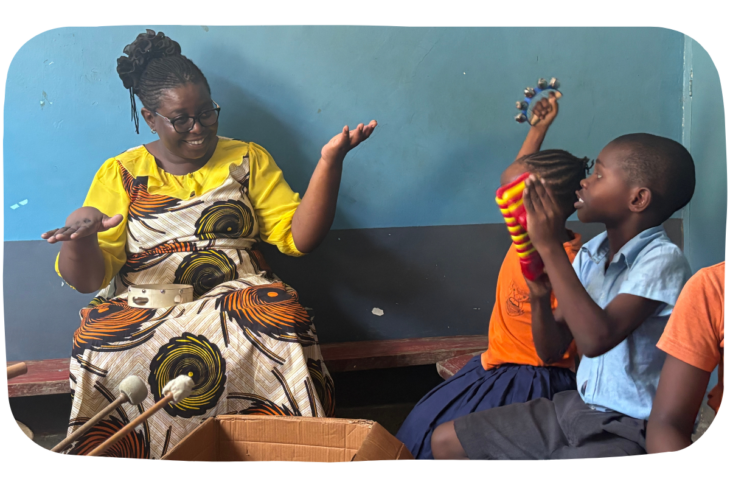
Last year, Sarah and Katy came to train our staff. At first we thought the training would be about singing and using instruments such as drums, but afterwards we realised it was different. It is not about teaching children to play in a certain way; it is about the pupil using the instrument as they are. Through this, we have seen a big change in our pupils. Many of them were quiet before, some struggled even to answer a question, but once they started attending the sessions, we could see the difference. They are happy, they enjoy themselves, they can answer questions, and they can lead one another. We are very pleased with what music therapy has brought to our school.
Why did you think music would help the children?
Music gives them freedom. In the sessions there is no guidance in the way we guide them during ordinary teaching, so they are free to lead one another and take part in any activity in the way they want. When you look at them, you can see how much they enjoy it. Where there was stress, they are now free. They laugh, and they interact with each other freely.
What were your first impressions when Sarah and Katy came to deliver the training?
At first we thought we were being taught how to use instruments, to sing, play and dance, so we thought we would become instructors ourselves. After the training, we found it was different from what we expected.
Since the training, your team has continued to use music. How does it work now, how frequently do sessions happen, and how many staff lead them?
We have six staff members, and we have divided our pupils into six groups. Each staff member works with six pupils, and each group attends a session at least once a week.
How do you encourage the children to keep going?
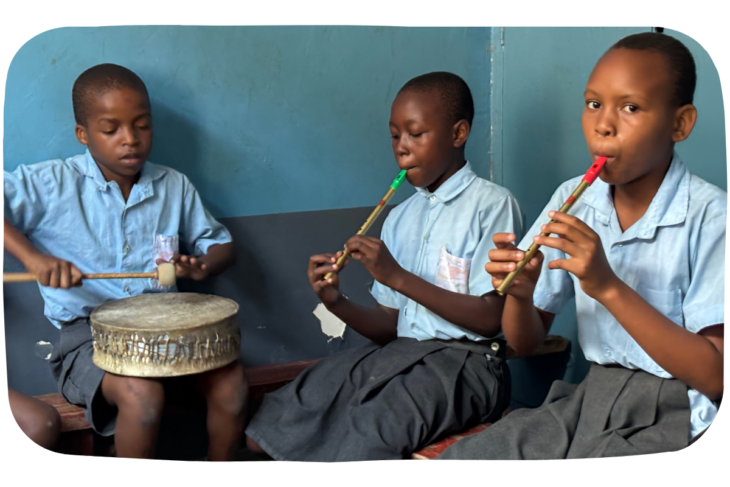
We encourage the pupils to be creative. Sometimes we ask them to lead us, to make a pattern for the rest of us to follow, and they come up with their own patterns. Sometimes they sing and the others follow. We encourage this even during their free time, and often they ask us themselves if they can come for a session, because they find it to be very enjoyable.
Have you had to encourage the staff to keep going with the sessions?
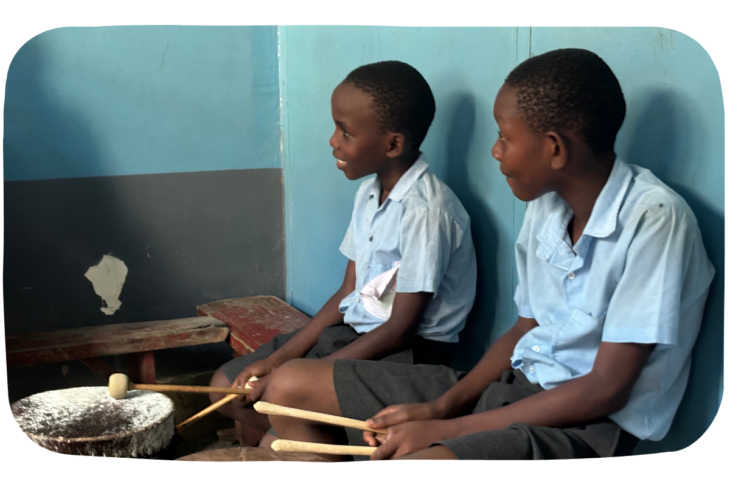
I talk to the staff regularly so that we keep going with the pupils using music therapy, because it helps them release stress. A pupilpupil may be carrying a burden through the day, but here they are able to release it, through the drums, the tambourine, and everything else. Afterwards, you find the pupil is much more active.
What benefits have you seen since the training started, either as a group or for individuals?
There are so many benefits. When I think about the pupils, at first they lacked confidence, but now the majority have confidence. When you ask someone to do something, they are sure of themselves and can do it well. Even when you talk to them, they can answer you, which was not the case before. This is especially true of the shy ones, who used to be afraid even to answer a question, they would just keep quiet even if they knew the answer. Now, when everybody is given a chance to participate, you see them taking part freely, and that in itself builds their confidence further. In class, they now have the confidence to ask questions when they do not understand, whereas before they were scared even of approaching the teachers. Singing and dancing together has made them free with us, and that has built a good relationship, between teacher and pupil, and among the pupils themselves.
Do you have a vision for the future of music at your school, or in Kenya more widely?
I would like to see more of our children being active, so that they can help other pupils too. When they go home, they meet children from other schools and tell them about what we do here, and those children become eager to see and to try the instruments for themselves, since many of them have never had the chance, only having seen instruments in pictures or on television. It would mean a great deal to see that reach spread further.
Is there anything else you would like to share?
I would like to say thank you for this programme, especially to Hazel and to Alexia. It has really helped our teachers and our pupils. There is a big change. The other day, when we were practising, everybody was very happy, and we did not want to finish. It was a lovely day together. That feeling is even stronger among the pupils. They always ask for music, and whenever they hear we have a free lesson, they want to come.
Related projects
-
Follow Up Visit (on-site): Bombolulu School of Promise (Mombasa) 2026
Kenya
- Caregivers
- Children